
Body Mass Index (BMI) is one of the quickest ways to check whether your weight is suitable for your height. Instead of guessing, you can enter your height and weight and see your result in a couple of seconds. In this guide, you will learn what BMI is, how it is calculated, how to read the categories, where BMI falls short, and how to use the free UtiliVox BMI Calculator step by step.
What Is BMI (Body Mass Index)?
BMI is a simple number calculated from your weight and height. It was designed as a screening measure to group adults into broad weight categories: underweight, normal weight, overweight, and obesity. Health organizations such as the World Health Organization (WHO) use BMI categories because they are easy to calculate, cost nothing, and work for large groups of people.
An important point: BMI is a screening tool, not a diagnosis. It tells you where your weight sits relative to your height, but it does not measure body fat directly, and it cannot tell you how healthy you are on its own.
About the UtiliVox BMI Calculator
The UtiliVox BMI Calculator is a free online tool in the Health & Fitness section of the site. It is built to give you a clear result without any sign-up, and it runs in your browser.
Key features
- Metric and Imperial units: switch between kg/cm and lb/ft-in with one toggle.
- Simple inputs: enter your age, sex, weight, and height.
- Instant result: see your BMI value and your weight category right away.
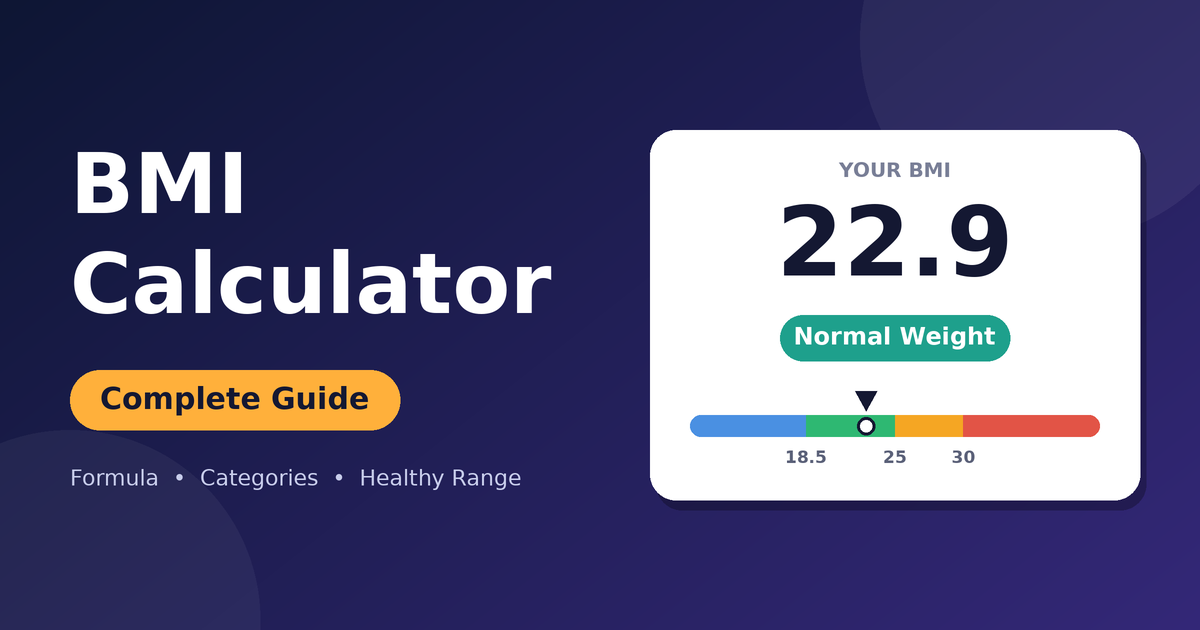
- Visual BMI meter: a color-coded scale (from 10 to 40+) with markers at 18.5, 25, and 30, so you can see exactly where you stand.
- Healthy weight range: the tool shows the weight range (in kg) that corresponds to a normal BMI for your height.
- Summary of your inputs: your age, sex, weight, and height are displayed with the result for easy checking.
- Reset button: clear everything and start again in one click.
- Built-in explanations: the page includes the formula, category ranges, accuracy limits, and FAQs.
How to Use the BMI Calculator (Step by Step)
- Open the tool using the button above.
- Choose your unit system: Metric (kg and cm) or Imperial (lb, feet and inches).
- Enter your age in years.
- Select your sex: Male or Female.
- Enter your weight in kg or lb, depending on the unit you chose.
- Enter your height in cm, or in feet and inches.
- Click “Calculate BMI”. Your BMI value, category, meter position, and healthy weight range will appear.
- Click “Reset” if you want to try different numbers.
If you see the message “Please enter valid height and weight values”, check that both fields contain positive numbers and that you selected the correct unit system.
BMI Formula
The calculator uses the standard BMI formulas:
| Unit system | Formula |
|---|---|
| Metric | BMI = weight (kg) ÷ height (m)² |
| Imperial | BMI = (weight in lb ÷ height in inches²) × 703 |
Worked examples
| Weight | Height | Calculation | BMI | Category |
|---|---|---|---|---|
| 70 kg | 175 cm (1.75 m) | 70 ÷ (1.75 × 1.75) = 70 ÷ 3.0625 | 22.9 | Normal weight |
| 85 kg | 170 cm (1.70 m) | 85 ÷ 2.89 | 29.4 | Overweight |
| 50 kg | 168 cm (1.68 m) | 50 ÷ 2.8224 | 17.7 | Underweight |
| 154 lb | 69 in (5 ft 9 in) | (154 ÷ 4761) × 703 | 22.7 | Normal weight |
BMI Categories for Adults
The calculator follows the standard adult categories used by the WHO. These apply to adults aged 20 and above.
| BMI | Category | What it generally means |
|---|---|---|
| Below 18.5 | Underweight | Weight may be too low for your height; nutrition and underlying causes may be worth checking. |
| 18.5 – 24.9 | Normal weight | Generally associated with the lowest health risk at the population level. |
| 25.0 – 29.9 | Overweight | Higher weight for your height; risk of some conditions starts to rise. |
| 30.0 – 34.9 | Obesity Class I | Increased health risk; lifestyle changes and medical advice are recommended. |
| 35.0 – 39.9 | Obesity Class II | Significantly increased health risk. |
| 40.0 or higher | Obesity Class III | Very high health risk; speak with a doctor. |
How to read the BMI meter
The meter on the tool runs from 10 to 40+ and is divided by three markers: 18.5 (the start of normal weight), 25 (the start of overweight), and 30 (the start of obesity). Your BMI is shown as a point on this scale, so you can see not only your category but also how close you are to the next one.
Healthy Weight Range by Height
A BMI between 18.5 and 24.9 is considered normal. The table below shows the matching weight range for common heights, so you can quickly see what “normal” looks like for you. The BMI Calculator also shows this range automatically for your own height.
| Height (cm) | Height (ft-in) | Normal weight range (kg) |
|---|---|---|
| 150 cm | 4 ft 11 in | 41.6 – 56.0 kg |
| 155 cm | 5 ft 1 in | 44.4 – 59.8 kg |
| 160 cm | 5 ft 3 in | 47.4 – 63.7 kg |
| 165 cm | 5 ft 5 in | 50.4 – 67.8 kg |
| 170 cm | 5 ft 7 in | 53.5 – 72.0 kg |
| 175 cm | 5 ft 9 in | 56.7 – 76.3 kg |
| 180 cm | 5 ft 11 in | 59.9 – 80.7 kg |
| 185 cm | 6 ft 1 in | 63.3 – 85.2 kg |
Does Age or Sex Change the BMI Result?
For adults, the BMI formula is the same for men and women, and age does not change the calculation. That is why the tool uses age and sex mainly for your result summary. However, it is worth knowing:
- At the same BMI, women usually carry more body fat than men.
- Older adults may lose muscle over time, so a “normal” BMI can hide a higher body-fat level.
- Under 18 years: adult categories do not apply. Children and teenagers should be assessed with BMI-for-age growth charts, ideally by a pediatrician.
Limitations of BMI
BMI is useful, but it is not perfect. Keep these limits in mind when you read your result:
| Situation | Why BMI can mislead |
|---|---|
| Athletes and bodybuilders | Muscle weighs more than fat, so BMI may show “overweight” even with low body fat. |
| Older adults | Loss of muscle can keep BMI in the normal range while body fat is high. |
| Pregnant women | Weight changes are expected; standard BMI categories do not apply. |
| Children and teenagers | Growth stages require age- and sex-specific percentile charts. |
| Different body types and ethnic groups | Health risk at a given BMI can differ between populations. Some health bodies suggest lower cut-off points for South Asian adults, so a BMI in the upper part of the normal range may still deserve attention. |
| Fat distribution | BMI does not show where fat is stored. Fat around the waist carries more risk than fat elsewhere. |
BMI vs Other Body Measurements
For a fuller picture of your health, use BMI together with other simple measures:
| Measure | What it tells you | Commonly used guide |
|---|---|---|
| BMI | Weight relative to height | 18.5 – 24.9 is normal for adults |
| Waist circumference | Abdominal fat and related risk | WHO: risk rises at 94 cm or more for men and 80 cm or more for women |
| Waist-to-height ratio | Central fat relative to height | Keeping your waist under half your height is a common target |
| Body fat percentage | Actual fat vs lean mass | Measured by body-composition scales or clinical tests |
Practical Tips to Reach or Maintain a Healthy BMI
- Eat balanced meals: include vegetables, fruit, protein, whole grains, and healthy fats.
- Watch portions and sugary drinks: liquid calories add up quickly.
- Move daily: aim for at least 150 minutes of moderate activity per week, such as brisk walking.
- Build muscle: strength exercises two or more days a week support a healthy metabolism.
- Sleep well: poor sleep is linked with weight gain and unhealthy cravings.
- Make gradual changes: slow, steady progress is easier to keep than crash diets.
- If underweight, focus on nutrient-rich foods and speak to a doctor to rule out medical causes.
When Should You See a Doctor?
Talk to a doctor or registered dietitian if your BMI falls in the underweight or obesity ranges, if your weight has changed suddenly without a reason, or if you have conditions such as diabetes, high blood pressure, or heart disease. A professional can look at your full health picture, which no calculator can do.
Frequently Asked Questions (FAQs)
What is a healthy BMI?
For adults, a BMI between 18.5 and 24.9 is considered healthy according to the WHO. Below 18.5 is underweight, 25 to 29.9 is overweight, and 30 or above is obesity.
Is the BMI calculator free to use?
Yes. The UtiliVox BMI Calculator is free, and you do not need to create an account to use it.
Is the BMI formula different for men and women?
No. The adult formula is the same for both sexes. However, women generally have a higher body-fat percentage than men at the same BMI, so the result should be read with that in mind.
Can athletes use BMI?
Athletes can use it, but the result may be misleading. Muscle is denser than fat, so a muscular person can have a high BMI without having excess body fat. Body-fat percentage and waist measurements give a better picture.
Can I use this calculator for children?
No. The adult categories are not suitable for people under 18. Children and teenagers should be assessed using BMI-for-age growth charts with a pediatrician or health professional.
Does BMI measure body fat?
No. BMI only compares weight with height. It is an indirect screening measure and does not separate fat, muscle, or bone.
Can I switch between kg/cm and lb/ft-in?
Yes. Use the unit toggle at the top of the calculator to switch between Metric and Imperial units before entering your values.
How often should I check my BMI?
Checking once every month or two is enough for most people. Weight naturally varies day to day, so frequent checks are not necessary.
Is my data saved when I use the tool?
The calculation runs in your browser using JavaScript. You can also press Reset at any time to clear the values you entered.
Is this tool a substitute for medical advice?
No. BMI is a screening measure, not a diagnosis. For personal health decisions, please consult a qualified healthcare professional.
Final Thoughts
BMI is a quick, free, and easy way to understand whether your weight is in a healthy range for your height. Used together with waist measurement, activity level, and advice from a doctor, it can help you set realistic health goals. Ready to find your number? Open the calculator, enter your details, and get your result in seconds.
This guide was written and reviewed by the UtiliVox Technical & Mathematics Team. We strictly verify formulas, algorithms, and real-world examples to provide actionable knowledge you can rely on.