
Ohm’s Law Calculator – Complete Guide
What Is Ohm’s Law?
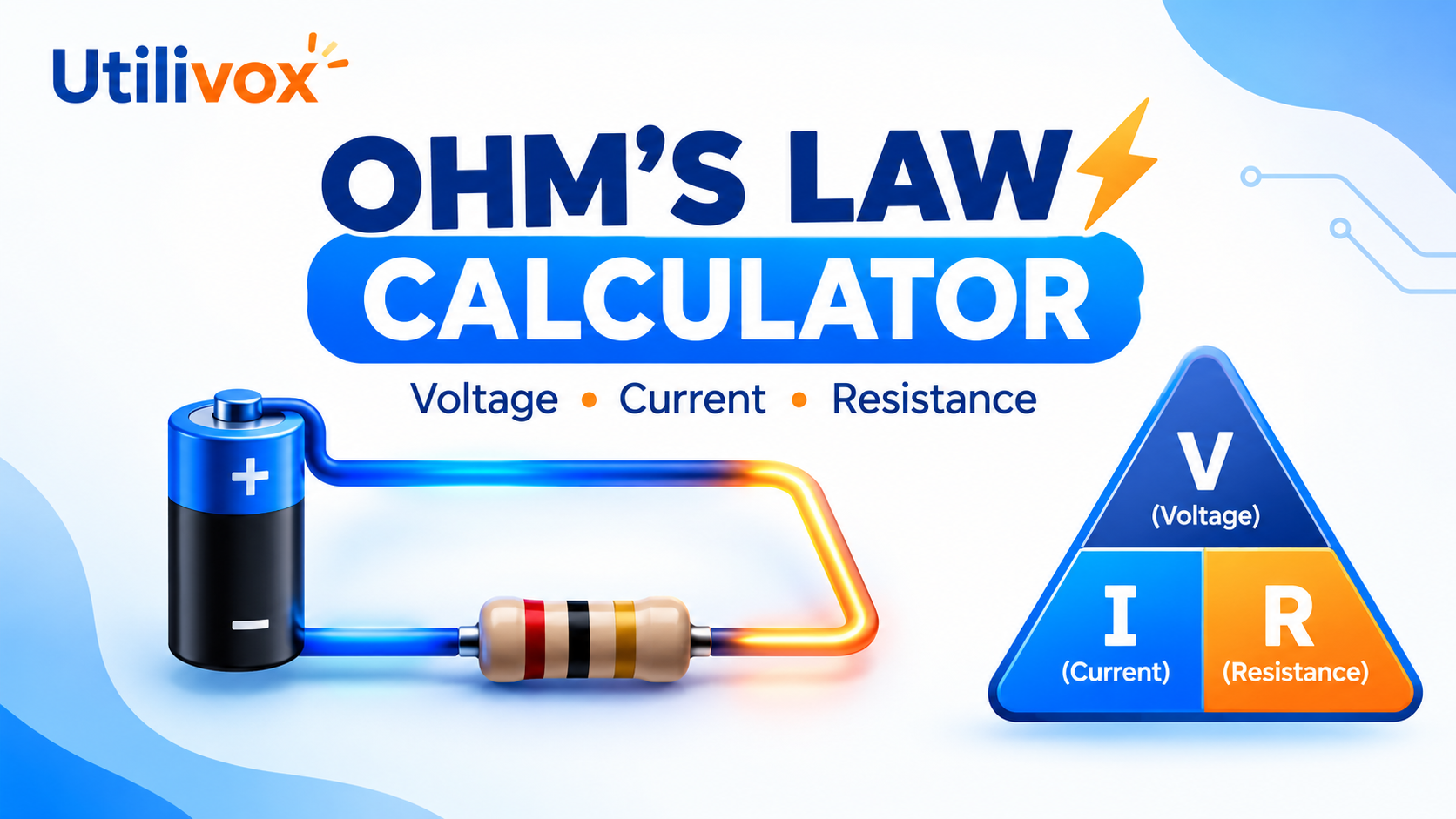
Ohm’s Law is a fundamental principle of electrical engineering that explains the relationship between voltage, current, and resistance in an electrical circuit. It helps students, electricians, engineers, and electronics enthusiasts calculate unknown electrical values quickly and accurately.
Our free Ohms Law Calculator at Utilivox makes it easy to calculate voltage, current, or resistance by entering the two known values. No manual calculations or complicated steps are required.
Ohm’s Law Formula
Ohm’s Law is represented by the following formulas:
- Voltage: V = I × R
- Current: I = V / R
- Resistance: R = V / I
Where:
- V (Voltage): Electrical potential difference, measured in volts (V).
- I (Current): The flow of electric charge, measured in amperes (A).
- R (Resistance): Opposition to the flow of electric current, measured in ohms (Ω).
How to Use the Ohms Law Calculator
Follow these simple steps to calculate electrical values:
- Select the electrical quantity you want to calculate: voltage, current, or resistance.
- Enter the two known values in the appropriate fields.
- Make sure your values use the correct units.
- Click the Calculate button.
- View your result instantly.
For example, if voltage is 12 volts and resistance is 4 ohms, the calculator determines the current flowing through the circuit.
Worked Example: Calculate Current
Given:
- Voltage = 12 V
- Resistance = 4 Ω
Formula: Current = Voltage / Resistance
Calculation: Current = 12 / 4 = 3 A
Answer: The electrical current is 3 amperes.
Worked Example: Calculate Voltage
Suppose a circuit has a current of 2 amperes and resistance of 10 ohms.
Formula: Voltage = Current × Resistance
Calculation: Voltage = 2 × 10 = 20 V
Answer: The voltage is 20 volts.
Worked Example: Calculate Resistance
Suppose the voltage across a component is 24 volts and the current is 3 amperes.
Formula: Resistance = Voltage / Current
Calculation: Resistance = 24 / 3 = 8 Ω
Answer: The resistance is 8 ohms.
Practical Applications of Ohm’s Law
Ohm’s Law is widely used in electrical and electronic applications, including:
- Designing and analyzing electrical circuits.
- Selecting suitable resistors for electronic components.
- Calculating current drawn by electrical devices.
- Troubleshooting basic electrical circuits.
- Understanding voltage drops across components.
- Learning electrical engineering and electronics fundamentals.
- Estimating electrical power when combined with power formulas.
Relationship Between Voltage, Current, and Resistance
Voltage drives current through a circuit, while resistance opposes the flow of current.
When resistance remains constant, increasing voltage increases current. When voltage remains constant, increasing resistance decreases current.
These relationships make Ohm’s Law useful for understanding how simple electrical circuits behave.
Ohm’s Law vs. Electrical Power
Ohm’s Law can also be used with electrical power formulas to calculate power consumption.
- Power = Voltage × Current: P = V × I
- Power = Current² × Resistance: P = I² × R
- Power = Voltage² / Resistance: P = V² / R
Power is measured in watts (W). These formulas help estimate the power dissipated by a resistive component.
Important Limitations of Ohm’s Law
Ohm’s Law applies directly to ohmic components when their resistance remains approximately constant under the conditions being considered.
It may not accurately describe components such as diodes, transistors, and incandescent lamps across all operating conditions because their voltage-current relationships can be nonlinear or change with temperature.
Always use suitable equipment and follow electrical safety precautions when working with real circuits.
Frequently Asked Questions (FAQs)
What does an Ohms Law Calculator do?
An Ohms Law Calculator calculates voltage, current, or resistance using the other two known values.
Is the Ohms Law Calculator free?
Yes. You can use the free Ohms Law Calculator on Utilivox without paying for basic calculations.
What is the basic formula of Ohm’s Law?
The basic formula is V = I × R, where V represents voltage, I represents current, and R represents resistance.
How do I calculate current?
Divide voltage by resistance. For example, 12 volts divided by 4 ohms equals 3 amperes.
What is the unit of resistance?
Resistance is measured in ohms, represented by the symbol Ω.
Can Ohm’s Law calculate voltage?
Yes. Multiply current in amperes by resistance in ohms to calculate voltage in volts.
Conclusion
Ohm’s Law is an essential concept for understanding electrical circuits and solving basic electrical problems. Utilivox’s free Ohms Law Calculator helps you calculate voltage, current, and resistance quickly, making it useful for students, beginners, and electronics enthusiasts.
Mathematical Formula
Step-by-Step Worked Example
Given I = 2A and R = 10 Ohm, V = 20V.
Continue your workflow with these verified calculators and utilities: