
Darts Calculator: Complete Guide to 301, 501, 701 and 1001 Scoring, Busts, Checkouts, Legs and Sets
Darts looks simple until you try to keep score. After every visit you have to subtract the points, remember the checkout rules, spot a bust, track legs and sets, and work out who throws next. One small mistake and the whole game is argued over. This guide explains how darts scoring works from the basics, how an online darts calculator removes the arithmetic, and how to read every result on the scoreboard. Every rule comes with an example, so you can check the numbers yourself.
Use the Free Darts Calculator →
Key Takeaways
- Each player starts on 301, 501, 701 or 1001 and subtracts every visit until the score reaches exactly zero.
- A visit is three darts, so the highest possible visit score is 180 (three treble 20s).
- In Double Out, the last dart must land in a double or the inner bull (50).
- A bust cancels the visit: overscoring, reaching zero without a double, or leaving 1 in Double Out.
- The highest possible checkout is 170, and the fewest darts to win a 501 leg is 9.
Table of Contents
- What Is a Darts Calculator?
- Dartboard and Scoring Basics
- Game Formats: 301, 501, 701 and 1001
- Double Out vs Straight Out
- Bust Rules With Examples
- Legs and Sets Explained
- How to Use the Darts Calculator
- Worked Example: A Full 501 Leg
- Scores and Checkouts That Are Impossible
- Common Checkouts Table
- Three-Dart Average Explained
- Tips to Score and Finish Better
- Official Dartboard Setup and Distances
- Common Scoring Mistakes
- Frequently Asked Questions
What Is a Darts Calculator?
A darts calculator is an online scoreboard that does the subtraction for you. You choose the game (301, 501, 701 or 1001), the number of players, and the finishing rule. After each visit you enter the total points the player scored, and the calculator shows the new remaining score, checks for a bust, and passes the turn to the next player.
| Task | Scoring by Hand | Using the Darts Calculator |
|---|---|---|
| Subtracting each visit | Mental maths or chalk, easy to get wrong | Done automatically after every visit |
| Spotting a bust | Players must remember every rule | Detected instantly and the score is restored |
| Checking a valid finish | Easy to forget that the last dart must be a double | Asks you to confirm the final dart |
| Tracking legs and sets | Tally marks on a board | Legs and sets counted for every player |
| Correcting a mistake | Rub out and argue about the earlier score | Undo the last turn with one click |
| Keeping a record | Usually lost when the board is wiped | Full score history on screen |
Dartboard and Scoring Basics
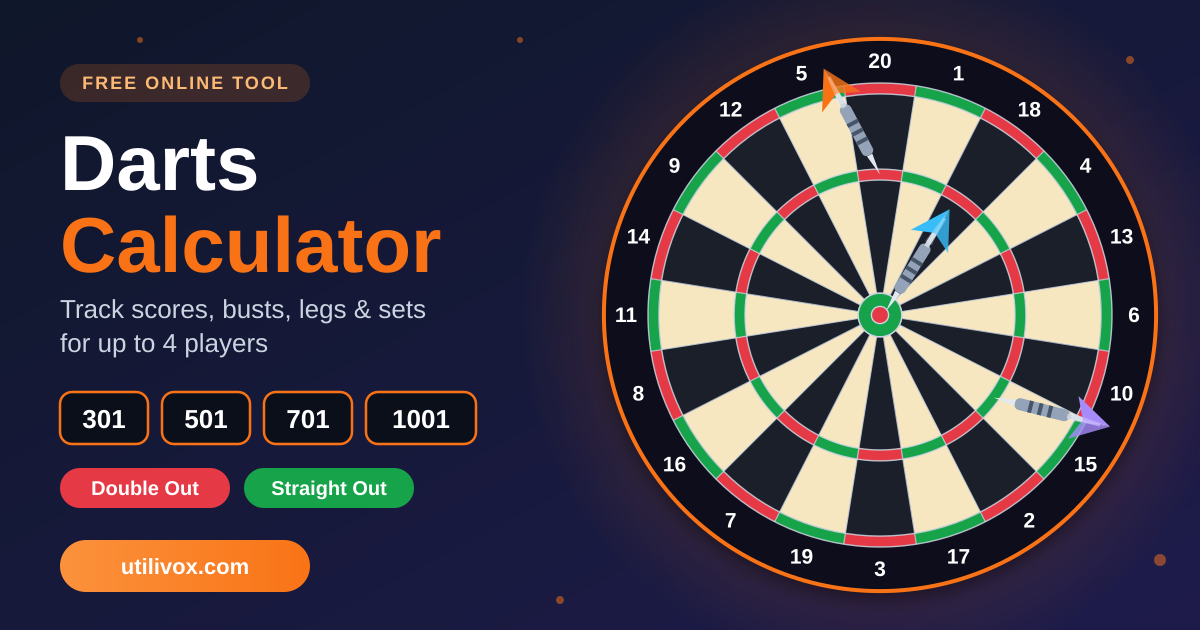
A standard dartboard has 20 numbered segments, an outer bull and an inner bull. Each number has three scoring areas: the large single areas, the thin outer ring (double) and the thin inner ring (treble). The numbers run around the board in this order: 20, 1, 18, 4, 13, 6, 10, 15, 2, 17, 3, 19, 7, 16, 8, 11, 14, 9, 12, 5.
| Area of the Board | How It Scores | Example |
|---|---|---|
| Single (large areas) | Face value of the number | Single 20 = 20 points |
| Double (outer thin ring) | 2 × the number | Double 20 = 40 points |
| Treble (inner thin ring) | 3 × the number | Treble 20 = 60 points |
| Outer bull (green ring) | 25 points | Does not count as a double |
| Inner bull (red centre, bullseye) | 50 points | Counts as a double for finishing |
The maximum for one dart is 60 (treble 20). Three darts make one visit (also called a turn), so the maximum for one visit is 3 × 60 = 180. This is why the calculator accepts a visit score from 0 to 180 only.
Game Formats: 301, 501, 701 and 1001
All formats work the same way. Each player starts on the same number and subtracts their scores until they reach exactly zero. The only difference is how long the game takes.
| Format | Starting Score | Best For | Fewest Darts Possible |
|---|---|---|---|
| 301 | 301 | Quick games, beginners and practice | 6 darts |
| 501 | 501 | The standard for league and competitive play | 9 darts (the “nine-darter”) |
| 701 | 701 | Longer casual games with friends | 12 darts |
| 1001 | 1001 | Very long games and team events | 17 darts |
For example, the 9-dart finish in 501 is 180 + 180 + 141, where 141 is made with treble 20, treble 19 and double 12 (60 + 57 + 24 = 141).
Double Out vs Straight Out
The finishing rule decides how a player must reach zero. The calculator lets you choose between the two.
| Feature | Double Out | Straight Out |
|---|---|---|
| Final dart | Must be a double or the inner bull (50) | Any scoring area |
| Reaching zero without a double | Bust | Not applicable, the leg is won |
| Leaving 1 point | Bust, because 1 cannot be finished with a double | Allowed, the player can finish with a single 1 |
| Scoring more than the remaining points | Bust | Bust |
| Typical use | Official and competitive matches | Beginners, kids and relaxed home games |
In Double Out, the calculator shows a checkbox for “Final dart was a double or inner bull”. Tick it only when the player finishes the leg, because the visit total alone cannot show which dart landed last.
Bust Rules With Examples
A bust means the visit does not count. The player’s score goes back to what it was before the visit, and the turn passes to the next player.
| Situation | Remaining Before | Visit Score | Result in Double Out | Result in Straight Out |
|---|---|---|---|---|
| Scores more than remaining | 30 | 31 | Bust, score stays 30 | Bust, score stays 30 |
| Reaches zero without a double | 40 | 40 (last dart not a double) | Bust, score stays 40 | Leg won |
| Leaves exactly 1 | 50 | 49 | Bust, score stays 50 | Valid, 1 remaining |
| Valid double finish | 40 | 40 (last dart double 20) | Leg won | Leg won |
Why 1 is a bust in Double Out: the smallest double is double 1, which is worth 2 points. There is no double worth 1, so a player left on 1 can never finish.
Legs and Sets Explained
A leg is one complete game from the starting score down to zero. A set is a group of legs. A match is a group of sets. The calculator uses a “first to” format for both.
| Term | Meaning | Example (First to 2 sets, first to 3 legs) |
|---|---|---|
| Leg | One game from 501 (or other start) to zero | One full game of 501 |
| Legs per set (first to) | Legs a player must win to take the set | Win 3 legs to win a set |
| Set | A won group of legs. Leg counts reset to 0 afterwards. | After 3 legs, the player gets 1 set |
| Sets (first to) | Sets a player must win to take the match | Win 2 sets to win the match |
The calculator lets you choose first to 1 to 5 sets and first to 1, 2, 3, 4, 5, 7 or 9 legs per set. For a quick single game, choose 1 set and 1 leg.
How to Use the Darts Calculator
- Choose the number of players: the calculator supports up to 4 players.
- Select the game: 301, 501, 701 or 1001.
- Set the match options: choose the sets and legs per set (first to).
- Choose the finish: Double Out for standard rules, or Straight Out for a relaxed game.
- Click New Game. Every player starts on the same score.
- Enter the visit score: type the total of the three darts (0 to 180) for the player whose turn it is.
- Confirm a double finish: in Double Out, tick the final-dart checkbox when the player checks out.
- Click Submit Score. The remaining score, bust check and next player update automatically.
- Fix a mistake: use Undo Last Turn, or Restart Match to begin again.
| Button or Field | What It Does |
|---|---|
| New Game | Starts a fresh game with your chosen settings |
| Submit Score | Records the visit and updates the scoreboard |
| Final dart checkbox | Confirms that the winning dart was a double or inner bull (Double Out only) |
| Undo Last Turn | Reverses the most recent entry, including a bust or a leg win |
| Restart Match | Resets the scores, legs and sets and begins the match again |
| Score History | Shows every visit that was entered |
Worked Example: A Full 501 Leg
Player A and Player B play 501, Double Out. Here is how Player A’s score goes down, and what the calculator shows.
| Visit | Player A Scores | Calculation | Remaining | Note |
|---|---|---|---|---|
| 1 | 85 | 501 − 85 | 416 | Normal visit |
| 2 | 100 | 416 − 100 | 316 | Normal visit |
| 3 | 140 | 316 − 140 | 176 | Normal visit |
| 4 | 60 | 176 − 60 | 116 | Normal visit |
| 5 | 76 | 116 − 76 | 40 | Leaves double 20 |
| 6 | 40 (not a double) | 40 − 40 = 0 | 40 | Bust, no double was confirmed |
| 7 | 40 (double 20) | 40 − 40 = 0 | 0 | Valid finish, leg won |
Visit 6 and visit 7 use the same score of 40, but only visit 7 is a valid finish, because the final dart was a double. This is why the calculator asks you to confirm the final dart in Double Out.
Scores and Checkouts That Are Impossible
Some totals cannot be made with three darts. The calculator rejects these so a wrong entry does not slip through.
| Type | Numbers | Why |
|---|---|---|
| Visit scores that cannot be made with three darts | 163, 166, 169, 172, 173, 175, 176, 178, 179 | No combination of three darts adds up to these totals. Anything above 180 is also impossible. |
| Double Out checkouts that cannot be made in one visit | 159, 162, 163, 165, 166, 168, 169 | These need more than three darts to finish with a double. Any total above 170 is also impossible. |
The highest checkout is 170: treble 20, treble 20, then the inner bull (60 + 60 + 50).
Common Checkouts Table
A checkout is the combination of darts that takes a player from the remaining score to zero. These are standard Double Out routes. Several routes often exist, and this table shows one common choice for each.
| Remaining | Checkout | Check |
|---|---|---|
| 170 | T20, T20, Bull | 60 + 60 + 50 |
| 167 | T20, T19, Bull | 60 + 57 + 50 |
| 164 | T20, T18, Bull | 60 + 54 + 50 |
| 161 | T20, T17, Bull | 60 + 51 + 50 |
| 160 | T20, T20, D20 | 60 + 60 + 40 |
| 140 | T20, T20, D10 | 60 + 60 + 20 |
| 130 | T20, T20, D5 | 60 + 60 + 10 |
| 120 | T20, 20, D20 | 60 + 20 + 40 |
| 110 | T20, Bull | 60 + 50 |
| 100 | T20, D20 | 60 + 40 |
| 90 | T20, D15 | 60 + 30 |
| 81 | T19, D12 | 57 + 24 |
| 70 | T10, D20 | 30 + 40 |
| 60 | 20, D20 | 20 + 40 |
| 50 | Bull | 50 |
| 40 | D20 | 40 |
| 36 | D18 | 36 |
| 32 | D16 | 32 |
T = treble, D = double, Bull = inner bull (50).
Three-Dart Average Explained
The three-dart average is the number of points a player scores, on average, with every three darts. It is the most common way to compare players of different levels.
| Method | Formula | Example |
|---|---|---|
| From darts thrown | (Total points ÷ Darts thrown) × 3 | (300 ÷ 9) × 3 = 100 |
| From visits (3 darts each) | Total points ÷ Number of visits | 300 ÷ 3 = 100 |
Important: a visit is already three darts, so you must not multiply the points-per-visit figure by 3 again. If a player scores 180 in three visits, the average is 180 ÷ 3 = 60, not 180. An average from visit scores is an estimate, because the calculator records visit totals, not the exact number of darts thrown (a checkout visit may use fewer than three darts).
As a rough guide to what an average means:
| Three-Dart Average | Rough Level |
|---|---|
| Under 40 | Beginner |
| 40 to 60 | Casual or improving player |
| 60 to 80 | Good pub or league player |
| 80 to 95 | Strong club or county player |
| 95 and above | Professional level |
These bands are only a rule of thumb. Averages in practice games and in match play can differ a lot.
Tips to Score and Finish Better
- Aim for the treble 20 early. It is the highest scoring target, and the 5 and 1 on either side are low, so accuracy matters.
- Leave a good double. Doubles such as D20 (40), D16 (32) and D8 (16) are easy to halve if you miss. Try to leave an even number you like.
- Avoid leaving 1, and be careful with odd numbers. In Double Out, an odd remainder needs a single first to set up an even finish.
- Plan the setup shot. From 41, for example, throw a single 1 to leave 40 (D20), instead of risking a bust.
- Learn the common checkouts. Knowing 40, 32, 36, 50, 60, 70, 81, 100 and 170 by heart saves thinking time.
- Use the calculator for practice. Track your own average over several 501 games and watch it improve.
- Practise doubles on their own. Many players score well but lose legs by missing the final double.
Official Dartboard Setup and Distances
If you are playing at home, set up the board to the standard measurements so your scores are fair and match what you would throw in a league.
| Measurement | Imperial | Metric |
|---|---|---|
| Height of the bullseye from the floor | 5 ft 8 in | 1.73 m |
| Throwing distance (oche to the face of the board) | 7 ft 9¼ in | 2.37 m |
| Diagonal from the bullseye to the oche | 9 ft 7⅛ in | 2.93 m |
Common Scoring Mistakes
| Mistake | Why It Causes Problems | Correct Way |
|---|---|---|
| Entering each dart separately | The calculator expects the total of the whole visit | Add the three darts first, then enter one number |
| Entering a score above 180 | It is impossible with three darts | Re-check the total, the maximum is 180 |
| Forgetting to tick the final-double box | A checkout without it is treated as a bust | Tick it only when the last dart was a double or inner bull |
| Ticking the box on a normal visit | The box only matters when the visit reaches zero | Leave it unticked unless the player is checking out |
| Counting the outer bull as a double | The outer bull (25) is not a double | Only the inner bull (50) counts as a double |
| Entering a bust score as a normal score | The score would be wrong for that visit | Enter the score the player threw, the calculator applies the bust rule itself |
| Using the wrong finish setting | Straight Out accepts finishes that Double Out would call a bust | Agree on Double Out or Straight Out before you start |
Frequently Asked Questions
How many players can use the darts calculator?
Up to 4 players can play in one game, and each player has their own remaining score, legs and sets.
What is the highest score possible in one visit?
180, which is three treble 20s (3 × 60).
What is the highest checkout in darts?
170, made with treble 20, treble 20 and the inner bull.
What is a nine-dart finish?
It is the perfect 501 leg, finished in the fewest possible darts. One example is 180 + 180 + 141 (T20, T19, D12 for the last visit).
Does the inner bull count as a double?
Yes. The inner bull is worth 50 and counts as a double, so it is a valid finishing dart in Double Out. The outer bull (25) does not count as a double.
Why is leaving 1 a bust in Double Out?
Because the smallest double is double 1, worth 2 points. No double is worth 1, so the player could never finish from 1.
What happens to my score after a bust?
The visit is cancelled and your score returns to what it was before that visit. The turn then passes to the next player.
What is the difference between a leg and a set?
A leg is one game from the starting score to zero. A set is a group of legs, and the match is a group of sets.
Which game should I choose, 301 or 501?
Choose 301 for a quick game or for beginners. Choose 501 for the standard competitive format.
Can I use the calculator for Straight Out?
Yes. Select Straight Out and the final dart can land anywhere, as long as the score reaches exactly zero.
Can I fix a wrong entry?
Yes. Click Undo Last Turn to reverse the most recent entry. You can also use Restart Match to start over with the same settings.
Is the three-dart average exact?
No. When it is worked out from visit totals, it is an estimate, because a checkout visit may use fewer than three darts.
Related Tools
This guide is for general information about darts scoring. Local leagues and tournaments may use slightly different rules, so confirm the rules with your organiser before a competitive match.
This guide was written and reviewed by the UtiliVox Technical & Mathematics Team. We strictly verify formulas, algorithms, and real-world examples to provide actionable knowledge you can rely on.