
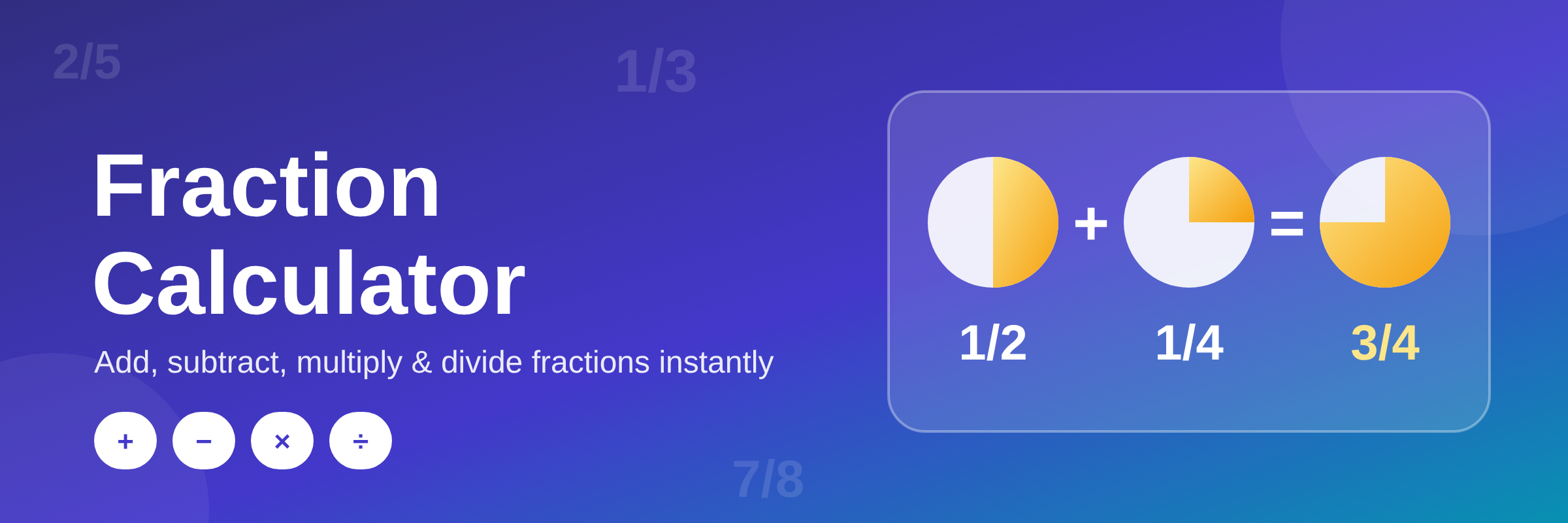
Fraction Calculator – Calculate Fractions Online
A Fraction Calculator is a free online math tool that helps you add, subtract, multiply, and divide fractions. It can also simplify fraction results and display answers as decimals and mixed numbers. Whether you are completing homework, checking calculations, or learning basic mathematics, an online fraction calculator makes working with fractions easier.
What Is a Fraction?
A fraction represents a part of a whole. It contains two numbers separated by a horizontal line. The top number is called the numerator, and the bottom number is called the denominator. For example, in 3/4, the numerator is 3 and the denominator is 4. The denominator must not be zero.
How to Use the Fraction Calculator
- Enter the numerator and denominator of the first fraction.
- Enter the numerator and denominator of the second fraction.
- Choose addition, subtraction, multiplication, or division.
- Click Calculate Fraction to see the result.
- Review the simplified fraction, decimal value, and mixed number when available.
Fraction Calculator Formulas
Adding Fractions
For fractions a/b and c/d, use (a × d + c × b)/(b × d). When denominators are equal, add the numerators and keep the denominator unchanged.
Subtracting Fractions
Use (a × d − c × b)/(b × d). If both denominators are equal, subtract the second numerator from the first.
Multiplying Fractions
Multiply the numerators together and multiply the denominators together: (a × c)/(b × d). Simplify the answer when possible.
Dividing Fractions
Keep the first fraction, multiply by the reciprocal of the second fraction, and simplify: (a/b) ÷ (c/d) = (a × d)/(b × c). The second fraction cannot equal zero.
Simplifying Fractions
Divide the numerator and denominator by their greatest common divisor (GCD). For example, 6/8 simplifies to 3/4 because both 6 and 8 can be divided by 2.
Step-by-Step Fraction Examples
Example 1: Add 1/2 and 1/3
Find a common denominator of 6. Convert 1/2 to 3/6 and 1/3 to 2/6. Add the numerators: 3/6 + 2/6 = 5/6.
Example 2: Subtract 3/4 − 1/4
The denominators are equal, so subtract the numerators: (3 − 1)/4 = 2/4. Simplify 2/4 to get 1/2.
Example 3: Multiply 2/3 × 3/5
Multiply the numerators and denominators: (2 × 3)/(3 × 5) = 6/15. Simplify 6/15 to get 2/5.
Example 4: Divide 3/4 ÷ 1/2
Reverse the second fraction and multiply: 3/4 × 2/1 = 6/4. Simplify the result to 3/2, which is also 1 1/2.
Proper, Improper, and Mixed Fractions
A proper fraction has a numerator smaller than its denominator, such as 2/5. An improper fraction has a numerator equal to or greater than its denominator, such as 7/4. A mixed number combines a whole number and a proper fraction, such as 1 3/4.
Where Are Fractions Used?
- Education: Solve math homework and check fraction exercises.
- Cooking: Adjust ingredient quantities in recipes.
- Measurements: Work with lengths, weights, and other divided quantities.
- Construction and DIY: Calculate fractional measurements for projects.
- Everyday calculations: Compare parts of a quantity and solve practical problems.
Common Fraction Calculation Mistakes
- Adding denominators directly when adding fractions with different denominators.
- Forgetting to multiply both numerators and denominators when multiplying fractions.
- Dividing without taking the reciprocal of the second fraction.
- Leaving a fraction unsimplified when it can be reduced.
- Using zero as a denominator or dividing by a fraction equal to zero.
Frequently Asked Questions
What does a fraction calculator do?
It calculates operations involving fractions, including addition, subtraction, multiplication, and division. This calculator also displays simplified results, decimal values, and mixed numbers.
How do you add fractions with different denominators?
Find a common denominator, convert both fractions to equivalent fractions with that denominator, add the numerators, and simplify the result.
How do you simplify a fraction?
Divide the numerator and denominator by their greatest common divisor. For example, 8/12 simplifies to 2/3 by dividing both numbers by 4.
Can a fraction be converted to a decimal?
Yes. Divide the numerator by the denominator. For example, 3/4 equals 0.75.
Can I divide by a fraction?
Yes, provided the second fraction is not zero. Multiply the first fraction by the reciprocal of the second fraction.
Why can't a denominator be zero?
Division by zero is undefined in ordinary arithmetic, so a fraction with a zero denominator does not have a valid numerical value.
Who can use an online fraction calculator?
Students, teachers, parents, and anyone who needs help solving fraction problems can use a fraction calculator for quick calculations and checking answers.
Calculate Fractions with Confidence
Fractions are an important part of mathematics and everyday problem-solving. Use the free Fraction Calculator above to perform common fraction operations, simplify results, and check your work. For learning purposes, try solving each problem manually before comparing your answer with the calculator.
Mathematical Formula
Addition: (a/b) + (c/d) = (ad + bc)/(bd)
Subtraction: (a/b) - (c/d) = (ad - bc)/(bd)
Multiplication: (a/b) × (c/d) = (ac)/(bd)
Division: (a/b) ÷ (c/d) = (ad)/(bc), where c ≠ 0
Simplification: Divide numerator and denominator by their greatest common divisor (GCD).
Decimal: Numerator ÷ Denominator
Step-by-Step Worked Example
Problem: Add 1/2 + 1/3
Step 1: Find the least common denominator.
The least common denominator of 2 and 3 is 6.
Step 2: Convert the fractions.
1/2 = 3/6
1/3 = 2/6
Step 3: Add the numerators.
3/6 + 2/6 = 5/6
Final Answer: 5/6
The fraction 5/6 is already in its simplest form.
Important Considerations & Limitations
The Fraction Calculator supports whole-number numerators and denominators. Decimal inputs are not supported in the fraction fields.
A denominator cannot be zero because division by zero is undefined.
Division by a second fraction equal to zero is not allowed.
Very large inputs may exceed the safe calculation range supported by JavaScript numbers.
Decimal results may be rounded for display, so use the simplified fraction when you need an exact fractional answer.
Mixed-number formatting follows standard arithmetic conventions and may display negative improper fractions with a negative whole-number part.
For important academic or professional calculations, verify your inputs and review the mathematical steps.
Continue your workflow with these verified calculators and utilities: